
HR-TEM Reveals Molecular Structure of Single-Crystalline 2D Polymer Networks
January 20, 2026 - Researchers from TU Dresden, Peking University (China), the Universities of Ulm and Malaga (Germany/Spain), and the Max Planck Institutes in Mainz and Halle (Germany) have developed a Mannich-elimination strategy that converts 2D imine-covalent organic frameworks into highly crystalline 2D poly(arylene vinylene)s. The approach enables synthesis of single-crystalline domains exceeding 2 micrometers - a significant advance over the 20 nm limit achieved with conventional methods. HR-TEM and continuous rotation electron diffraction reveal the molecular-level honeycomb structure, while benzotrithiophene-based variants exhibit charge mobilities tenfold higher than their amorphous counterparts.
Two-dimensional conjugated covalent organic frameworks (2D c-COFs), also known as crystalline 2D conjugated polymers, represent a unique class of organic 2D crystals featuring extended in-plane pi-conjugation and out-of-plane electronic couplings.[1],[2],[3],[4],[5] These layered materials are typically interconnected by conjugated linkages such as imine and pyrazine groups.[6],[5] However, the polarized C=N bonds in these structures hinder efficient pi-electron delocalization, often resulting in large optical band gaps and inefficient charge carrier transport.[7] Recent advances in layered 2D poly(arylene vinylene)s (2D PAVs) have demonstrated significantly enhanced pi-conjugation compared to their imine-linked counterparts (also known as 2D polyimines or 2D PIs).[8],[9] Thanks to their tunable topologies, tailored electronic structures, intrinsic charge carrier mobilities, and abundant active sites, these materials have attracted considerable attention for applications in optoelectronics and photocatalysis.[4],[10],[9],[11],[12]
Since the first report of crystalline 2D PAVs via Knoevenagel 2D polycondensation, various synthetic methodologies have been developed to construct this class of materials, including Aldol-type, Horner-Wadsworth-Emmons, Wittig, and Claisen-Schmidt 2D polycondensation reactions.[13],[14],[15],[16],[17],[18] However, domain sizes achieved through these methods are generally below 20 nm, limiting their potential for wide-scope applications. Moreover, unlike the excellent generality of well-established Schiff-base 2D polycondensation, only selected 2D PAVs achieve crystallinity due to the considerably lower reversibility of C=C bond formation compared to C=N bonds.[19] Synthesizing 2D PAVs with robust topologies and high crystallinity (domain sizes exceeding 100 nm) therefore remains a significant challenge, requiring deep understanding of reaction kinetics and precise control over reaction reversibility.
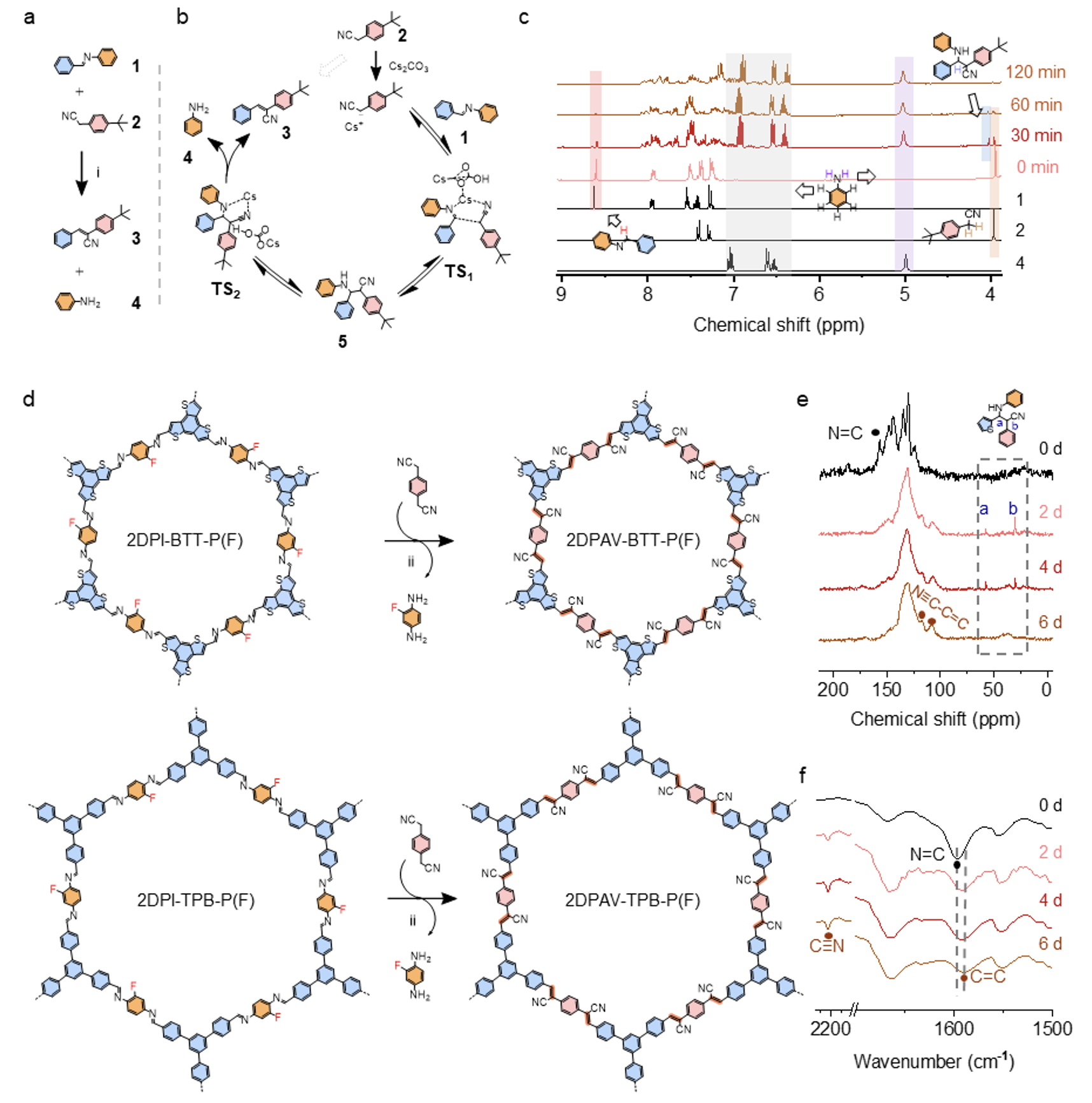
The Mannich reaction has been widely utilized in the synthesis of bioactive compounds.[20] When combined with an elimination process, the Mannich-elimination reaction (also known as retro-Michael addition-elimination reaction) enables facile C=C bond formation using either base (such as KOH) or Lewis acid (such as In(OTf)3) catalysts.[21] To assess the feasibility of this reaction for synthesizing 2D PAVs, the researchers investigated the reaction mechanism through a series of model reactions and DFT calculations. In a representative model reaction, the Mannich-elimination reaction between (E)-N,1-diphenylmethanimine (1) and 2-(4-(tert-butyl)phenyl)acetonitrile (2) proceeds via a two-step process (Fig. 1a and 1b): C-C bond formation between the imine and the active methylene generates the intermediate addition product 5, followed by an elimination process that forms the cyano-vinylene bond in (Z)-2-(4-(tert-butyl)phenyl)-3-phenylacrylonitrile (3) with aniline (4) as the byproduct.
To determine whether the reaction follows the Mannich-elimination pathway or involves imine hydrolysis to an aldehyde followed by Knoevenagel condensation, the team performed in-situ 1H nuclear magnetic resonance (NMR) analysis using Cs2CO3 as the catalyst and DMAc/H2O as the solvent. The spectra display decreased intensity of the imine (1) and cyano-methylene (2) protons at 8.6 and 3.9 ppm, respectively, accompanied by gradual appearance of the amine proton (4) at 5.0 ppm over 240 minutes (Fig. 1c). Furthermore, the formation of intermediate addition product 5 was detected by 1H NMR, with a characteristic cyano-C-H proton signal at 4.06 ppm appearing after 30 minutes of reaction and fully disappearing after 120 minutes as product 3 formed (Fig. 1c).[22] The intermediate 5 was further verified by various mass spectrometry analyses, supporting the proposed reaction mechanism shown in Fig. 1b.
The scientists monitored the transformation of C2-symmetric 1,4-phenylenediacetonitrile into 2DPAV-BTT-P(F) and 2DPAV-TPB-P(F) (Fig. 1d) using solid-state 19F/13C cross polarization (CP) NMR and Fourier-transform infrared (FT-IR) spectroscopy. The ex-situ 13C CP NMR spectra show peaks at 57 and 30 ppm for the isolated polymers after one day of synthesis, corresponding to formation of the intermediate addition product (Fig. 1e). Additionally, the ex-situ FT-IR spectra reveal that the stretching vibration of the imine bond at 1597 cm-1 gradually shifts to 1590 cm-1 (C=C) due to formation of cyano-vinylene linkages in 2DPAV-BTT-P(F) (Fig. 1f).
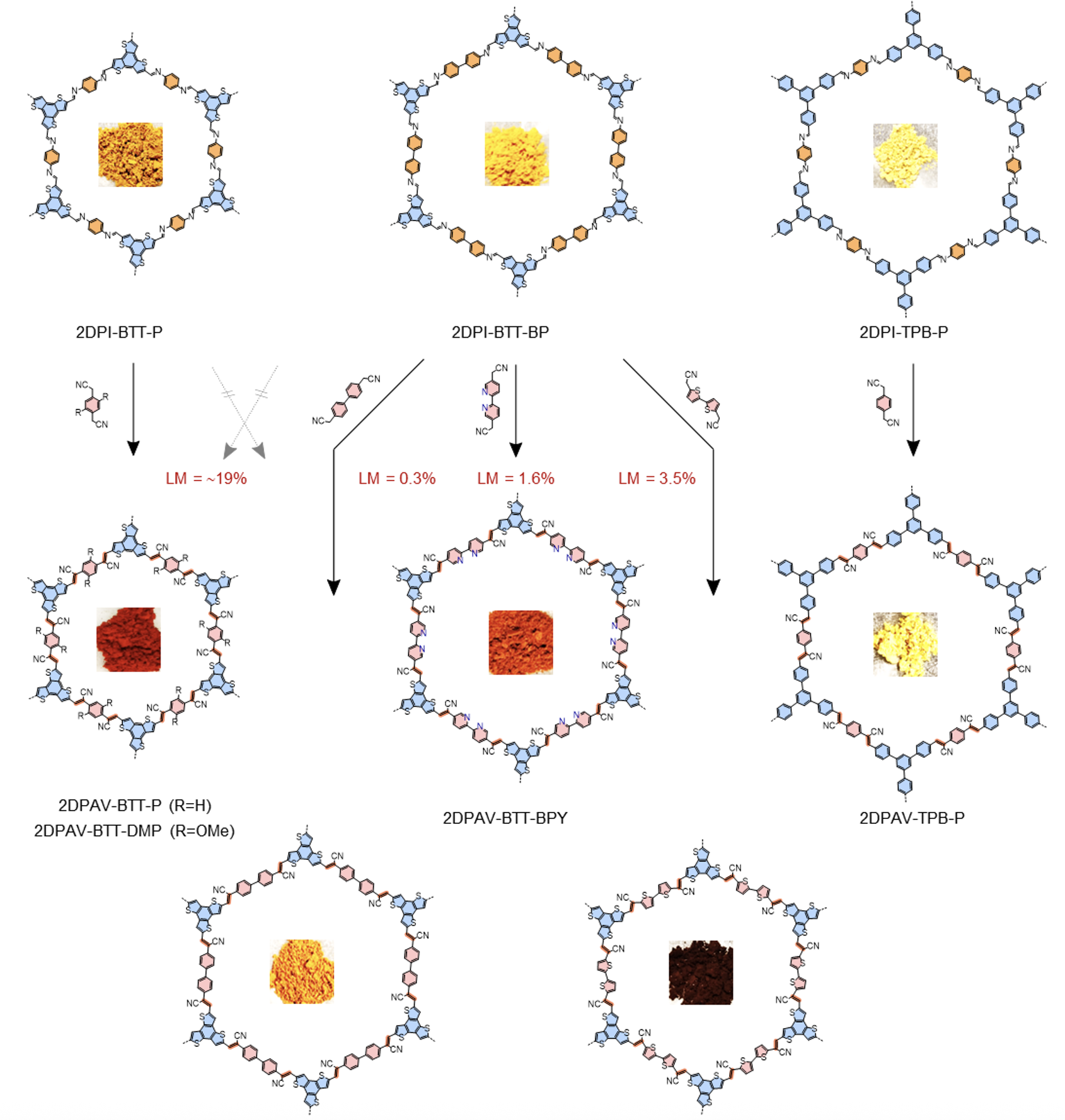
Encouraged by these results, the researchers synthesized unlabeled powder-form compounds 2DPI-BTT-P and 2DPI-TPB-P, which exhibit dark yellow and light yellow colors, respectively (Fig. 2). Due to the high symmetry of the unlabeled building block, these materials show improved crystallinity compared to F-labeled 2D-PIs, leading to better layer stacking. Using the Mannich-elimination reaction, 2DPAV-BTT-P and 2DPAV-TPB-P were subsequently obtained as red and light yellow powders, respectively (Fig. 2). The team also synthesized a series of BTT-based 2D PAVs with different electronic structures from 2DPI-BTT-BP (yellow powders) via the Mannich-elimination reaction: 2DPAV-BTT-BP (light orange), 2DPAV-BTT-BPY (dark orange; BPY = bipyridine), and 2DPAV-BTT-BT (dark brown; BT = bithiophene), as shown in Fig. 2.
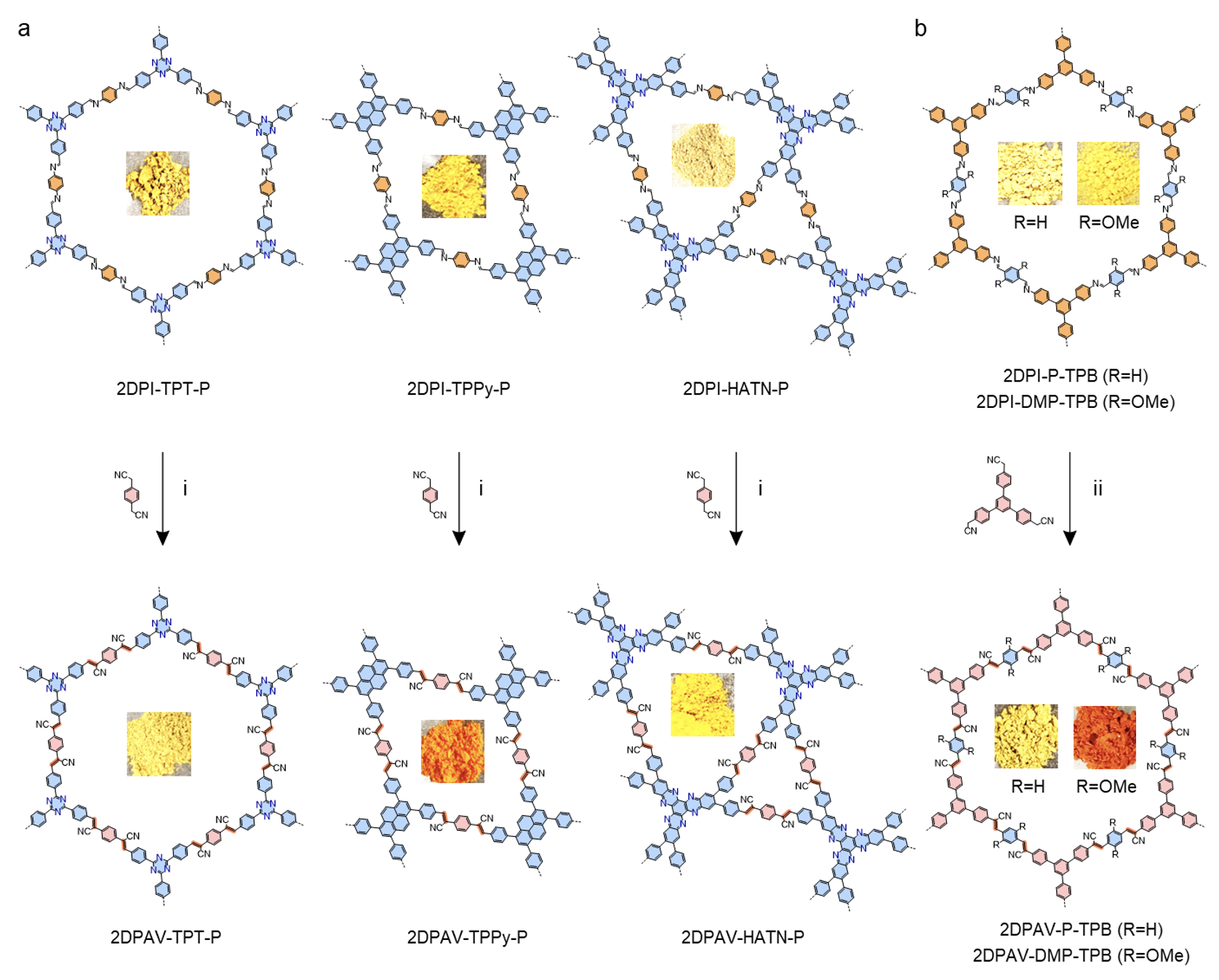
As shown in Fig. 3a, the Mannich-elimination synthetic strategy also proves powerful for synthesizing three additional highly crystalline 2D PAVs with honeycomb, square, or kagome lattices based on C2-symmetric acetonitrile monomers: 2DPAV-TPT-P (TPT = triphenyltriazine; yellow), 2DPAV-TPPy-P (TPPy = tetraphenylpyrene; orange), and 2DPAV-HATN-P (HATN = hexaazatrinaphthalene; yellow). Notably, their BET surface areas are nearly twice those of 2D PAVs directly synthesized via the Knoevenagel approach. The synthetic strategy can be further extended to construct 2D PAVs based on C3-symmetric acetonitrile building blocks. For instance, honeycomb 2DPAV-P-TPB and 2DPAV-DMP-TPB were successfully synthesized as yellow and dark orange powders, respectively, from 2,2'-(5'-(4-(cyanomethyl)phenyl)-[1,1':3',1''-terphenyl]-4,4''-diyl)diacetonitrile (Fig. 3b). However, transformation of C3-symmetric building blocks is more challenging, requiring harsher synthetic conditions of 8 equivalents of base per C=N bond at 130 degrees C for 12 days to achieve full conversion.
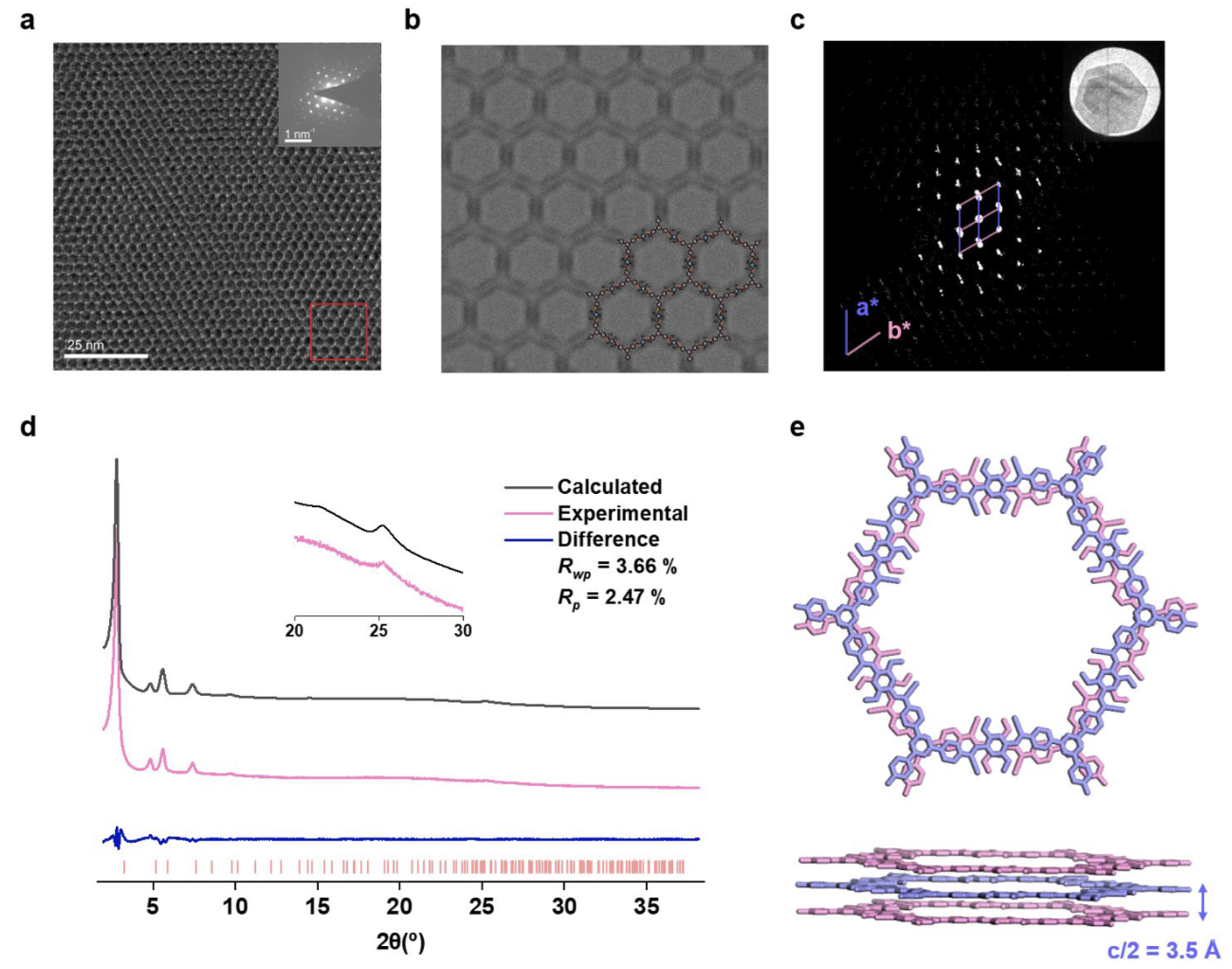
The study further demonstrates the synthesis of single-crystalline 2DPI-DMP-TPB under solvothermal conditions.[23] TEM images reveal a flake-like morphology for the hexagonal 2D PI crystals with domain sizes exceeding 2 micrometers. After Mannich-elimination transformation, the resulting 2DPAV-DMP-TPB crystal maintains the hexagonal morphology of the 2D PI precursor, showing a domain size of approximately 2 micrometers. HR-TEM images reveal its honeycomb polymer framework at the molecular level (Fig. 4a) with a lattice distance of 3 nm, qualitatively agreeing with the simulated structure (Fig. 4b). Continuous rotation electron diffraction (cRED) collected in low-dose mode at 99 K (Fig. 4c) revealed a hexagonal unit cell with parameters a = b = 36.55 Angstrom, c = 7.13 Angstrom, and beta = 120 degrees for 2DPAV-DMP-TPB. To validate the crystal structure, the PXRD pattern was simulated from the cRED-derived structural model and further refined by Rietveld analysis (Fig. 4d). Top and side views of the single-crystalline structure are shown in Fig. 4e.
Resource:
Ghouse, S., Guo, Z., Gamez-Valenzuela, S. et al. (2026).
Towards single-crystalline two-dimensional poly(arylene vinylene) covalent organic frameworks.
Nat. Chem. 2026.
https://doi.org/10.1038/s41557-025-02048-8
-
Ascherl, L. et al. (2016). Molecular docking sites designed for the generation of highly crystalline covalent organic frameworks. Nat. Chem., 8, 310-316. https://doi.org/10.1038/nchem.2444
-
Wang, M. et al. (2023). Exceptionally high charge mobility in phthalocyanine-based poly(benzimidazobenzophenanthroline)-ladder-type two-dimensional conjugated polymers. Nat. Mater., 22, 880-887. https://doi.org/10.1038/s41563-023-01581-6
-
Galeotti, G. et al. (2020). Synthesis of mesoscale ordered two-dimensional pi-conjugated polymers with semiconducting properties. Nat. Mater., 19, 874-880. https://doi.org/10.1038/s41563-020-0682-z
-
Wang, Z., Wang, M., Heine, T. & Feng, X. (2025). Electronic and quantum properties of organic two-dimensional crystals. Nat. Rev. Mater., 10, 147-166. https://doi.org/10.1038/s41578-024-00740-8
-
Wang, M. et al. (2019). Unveiling electronic properties in metal-phthalocyanine-based pyrazine-linked conjugated two-dimensional covalent organic frameworks. J. Am. Chem. Soc., 141, 16810-16816. https://doi.org/10.1021/jacs.9b07644
-
Gruber, C. G., Frey, L., Guntermann, R., Medina, D. D. & Cortes, E. (2024). Early stages of covalent organic framework formation imaged in operando. Nature, 630, 872-877. https://doi.org/10.1038/s41586-024-07483-0
-
Cusin, L., Peng, H., Ciesielski, A. & Samori, P. (2021). Chemical conversion and locking of the imine linkage: enhancing the functionality of covalent organic frameworks. Angew. Chem. Int. Ed., 60, 14236-14250. https://doi.org/10.1002/anie.202016667
-
Liu, Y. et al. (2023). A thiophene backbone enables two-dimensional poly(arylene vinylene)s with high charge carrier mobility. Angew. Chem. Int. Ed., 62, e202305978. https://doi.org/10.1002/anie.202305978
-
Liu, R. et al. (2024). Linkage-engineered donor-acceptor covalent organic frameworks for optimal photosynthesis of hydrogen peroxide from water and air. Nat. Catal., 7, 195-206. https://doi.org/10.1038/s41929-023-01102-3
-
Wang, Y. et al. (2022). Facile construction of fully sp2-carbon conjugated two-dimensional covalent organic frameworks containing benzobisthiazole units. Nat. Commun., 13, 100. https://doi.org/10.1038/s41467-021-27573-1
-
Bi, S. et al. (2022). Heteroatom-embedded approach to vinylene-linked covalent organic frameworks with isoelectronic structures for photoredox catalysis. Angew. Chem. Int. Ed., 61, e202111627. https://doi.org/10.1002/anie.202111627
-
Liu, M. et al. (2022). Two-dimensional covalent organic framework films prepared on various substrates through vapor induced conversion. Nat. Commun., 13, 1411. https://doi.org/10.1038/s41467-022-29050-9
-
Zhuang, X. et al. (2016). A two-dimensional conjugated polymer framework with fully sp2-bonded carbon skeleton. Polym. Chem., 7, 4176-4181. https://doi.org/10.1039/C6PY00561F
-
Jin, E. et al. (2017). Two-dimensional sp2 carbon-conjugated covalent organic frameworks. Science, 357, 673-676. https://doi.org/10.1126/science.aan0202
-
Jadhav, T. et al. (2019). 2D poly(arylene vinylene) covalent organic frameworks via aldol condensation of trimethyltriazine. Angew. Chem. Int. Ed., 58, 13753-13757. https://doi.org/10.1002/anie.201906976
-
Pastoetter, D. L. et al. (2020). Synthesis of vinylene-linked two-dimensional conjugated polymers via the Horner-Wadsworth-Emmons reaction. Angew. Chem. Int. Ed., 59, 23620-23625. https://doi.org/10.1002/anie.202010398
-
Liu, Y. et al. (2022). Vinylene-linked 2D conjugated covalent organic frameworks by Wittig reactions. Angew. Chem. Int. Ed., 61, e202209762. https://doi.org/10.1002/anie.202209762
-
Niu, C.-P., Zhang, C.-R., Liu, X., Liang, R.-P. & Qiu, J.-D. (2023). Synthesis of propenone-linked covalent organic frameworks via Claisen-Schmidt reaction for photocatalytic removal of uranium. Nat. Commun., 14, 4420. https://doi.org/10.1038/s41467-023-40169-1
-
Ma, T. et al. (2018). Single-crystal x-ray diffraction structures of covalent organic frameworks. Science, 361, 48-52. https://doi.org/10.1126/science.aat7679
-
Arrayas, R. G. & Carretero, J. C. (2009). Catalytic asymmetric direct Mannich reaction: a powerful tool for the synthesis of alpha,beta-diamino acids. Chem. Soc. Rev., 38, 1940-1948. https://doi.org/10.1039/B820303B
-
Selvi, T. & Velmathi, S. (2018). Indium(III) triflate-catalyzed reactions of aza-Michael adducts of chalcones with aromatic amines: retro-Michael addition versus quinoline formation. J. Org. Chem., 83, 4087-4091. https://doi.org/10.1021/acs.joc.7b03151
-
Poisson, T., Gembus, V., Oudeyer, S., Marsais, F. & Levacher, V. (2009). Product-catalyzed addition of alkyl nitriles to unactivated imines promoted by sodium aryloxide/ethyl(trimethylsilyl)acetate (ETSA) combination. J. Org. Chem., 74, 3516-3519. https://doi.org/10.1021/jo802763b
-
Natraj, A. et al. (2022). Single-crystalline imine-linked two-dimensional covalent organic frameworks separate benzene and cyclohexane efficiently. J. Am. Chem. Soc., 144, 19813-19824. https://doi.org/10.1021/jacs.2c07166