
Electron-Beam Phase Engineering of Monolayer MoTe2

January 15, 2024 – Researchers from Ulm University and Helmholtz-Zentrum Dresden-Rossendorf (Germany) and Aalto University (Finland) have achieved controlled phase transformations in single-layer MoTe2 using electron beams. Using aberration-corrected HRTEM at the SALVE microscope operating at 40–80 kV, the team demonstrated how semiconducting H-MoTe2 can be transformed into metallic Mo6Te6 nanowires through controlled defect evolution. The findings reveal that graphene encapsulation provides excellent protection against radiation damage, opening new pathways for phase engineering applications in 2D materials for future electronic and spintronic devices.
Hexagonal molybdenum ditelluride (H-MoTe2) is a semiconductor with fascinating properties: it undergoes a transition from an indirect to a direct band gap when thinned from bulk material (0.88 eV) to single layers (1.10 eV).[1],[2] This material can exist in multiple phases, with the transformation from the semiconducting hexagonal (H) phase to the metallic monoclinic (T') phase being relatively straightforward to achieve.[3] Under thermodynamic equilibrium, this H-T' phase transition occurs at temperatures between 400 °C and 800 °C, depending on the concentration of tellurium atoms in the system.[4] Several pathways for inducing this transformation have been explored in MoTe2 and other transition metal dichalcogenides (TMDs): creating chalcogen deficiencies through laser irradiation,[3] electron beam exposure,[5] or in the case of MoS2, atomic force microscopy.[6] Theoretical studies have also analyzed the contributions of various factors to these transformations.[7]
One-dimensional structures known as nanowires (NW), with the formula M6X6 (where M = Mo, W and X = S, Se, Te), can exhibit metallic character.[8],[9] Interestingly, most phase diagrams do not predict or consider this 1D phase.[4] Researchers have fabricated these nanowires using various methods, such as employing low chalcogenide flux during growth on different substrates, which enables the production of either pure 1D materials or partially transformed structures.[10],[11],[12] The remarkable electronic properties of these nanowires make them promising candidates for applications in battery materials[13],[14] and high-performance supercapacitors.[10]
For investigating temperature-dependent transformations in freestanding two-dimensional hexagonal MoTe2 layers, aberration-corrected high-resolution transmission electron microscopy (AC-HRTEM) proves indispensable. This technique enables characterization of atomic-level transformations in real time. The TEM electron beam also provides a means to control the molybdenum-to-tellurium ratio in atomically thin TMD layers.[15]
Both elastic (knock-on) and inelastic (radiolysis) damage mechanisms—as well as combinations thereof[16]—can create chalcogenide atom deficiencies in MoTe2, leading to the in-situ formation of isolated defects with diverse properties.[17],[18] When high concentrations of Mo atoms accumulate in the atomically thin layer, 4|4P mirror twin boundaries (MTBs) can form.[18],[19] Studies on MoSe2 and MoS2 have further demonstrated that freestanding nanowires can grow within single layers during (S)TEM imaging when large holes are induced in the 2D material by the electron beam.[20]
To shield 2D materials from electron beam damage, encapsulating TMDs between graphene layers has proven effective. This approach reduces both elastic and inelastic damage contributions during TEM imaging.[21] Previous investigations[18],[21] established the foundation for understanding electron-sample interactions in single-layer MoTe2.
Several important questions remained unanswered: How does the tellurium atom sputtering rate change under electron irradiation at different energies? What happens to single-layer MoTe2 after the layer structure decomposes under electron irradiation—and can this electron-sample interaction be suppressed? How does thermal annealing affect the morphology of single-layer MoTe2, and how do its effects differ from those of electron beam irradiation?
To address these questions, the research team developed a careful sample preparation protocol. After depositing MoTe2 flakes onto a silicon/silicon dioxide wafer previously coated with polyvinyl alcohol (PVA) and polymethyl methacrylate (PMMA) (Fig. 1(a)), suitable flakes were identified using optical microscopy. The PMMA layer was then transferred onto a MEMS (microelectromechanical system) chip (Fig. 1(b)). For graphene-encapsulated samples, the team prepared structures by iterative mechanical exfoliation and sequential transfer of three individual flakes onto a TEM grid,[22] followed by thermal annealing (Fig. 1(c)). High-resolution TEM imaging was performed at room temperature using a CC/CS-corrected sub-angstrom low-voltage electron microscope (SALVE) operating at 80 kV.[23]
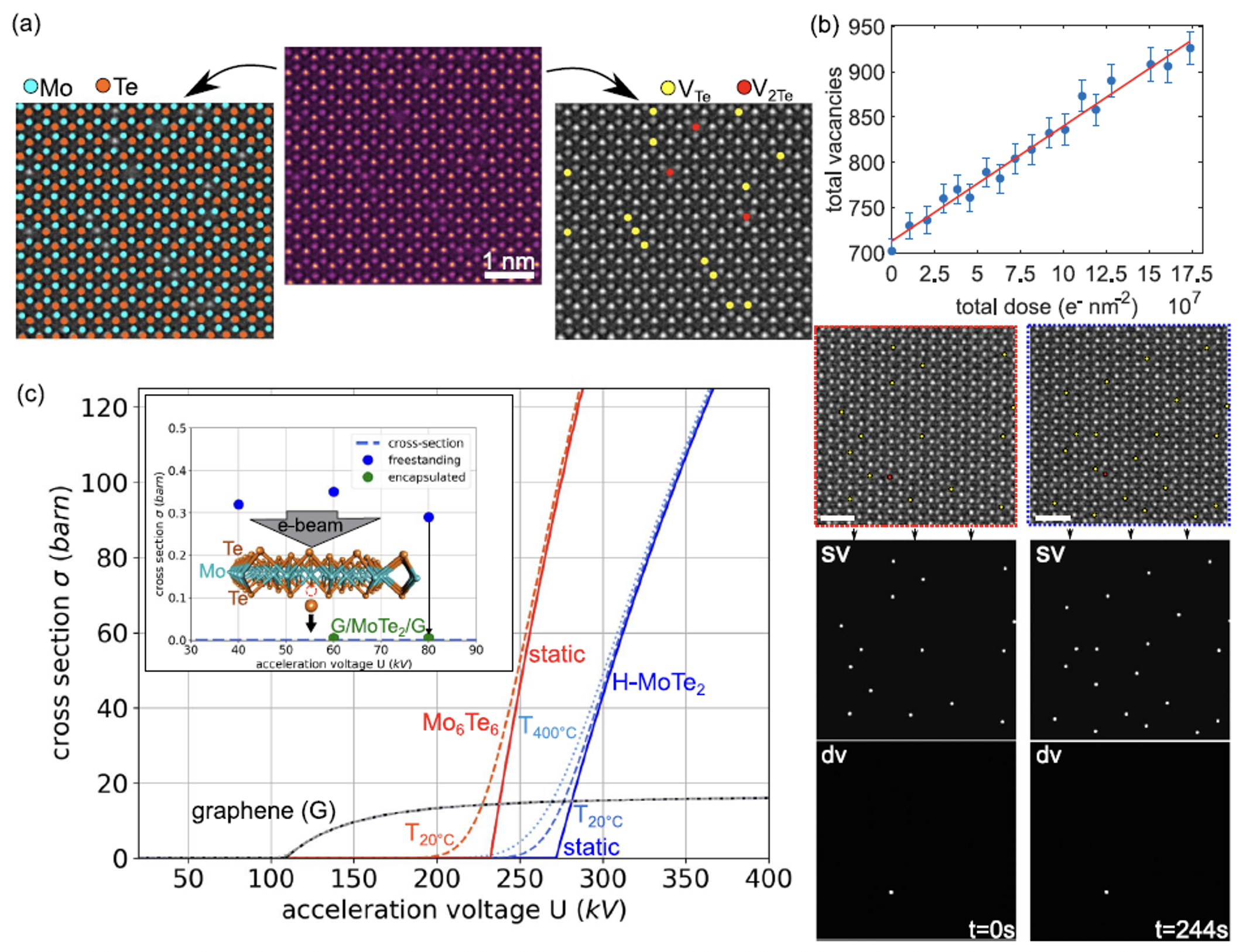
The damage cross-section analysis revealed striking results. Figure 2(a) shows a color-coded, CC/CS-corrected HRTEM image of single-layer H-MoTe2 acquired at 60 kV. As observed in MoS2 and MoSe2,[21],[22] continuous electron irradiation induces defect formation in single-layer H-MoTe2.[18] The structural evolution begins with the formation of isolated single (VTe) and double tellurium vacancies (V2Te), similar to observations at 40 kV.[17] To enable quantitative analysis of vacancy distributions, the researchers employed a specially trained convolutional neural network (CNN) based on the U-Net architecture. This approach allowed automatic detection of VTe and V2Te defects across numerous images by determining atomic positions, atom types, and isolated defects. The team analyzed vacancy formation in the linear regime, where the increase in vacancy number follows an approximately linear relationship with applied electron dose (see Fig. 2(b)).
The experimentally determined damage cross-sections for single-layer H-MoTe2 at 40 kV, 60 kV, and 80 kV appear in the inset of Figure 2(c). All three voltages yield values of similar magnitude—on the order of several barn—which are significantly lower than literature values[21],[22],[24] reported for single-layer H-MoS2 and H-MoSe2. This finding demonstrates that single-layer H-MoTe2 exhibits intrinsically lower radiation damage than other molybdenum-based TMDs across the investigated voltage range.
To elucidate the underlying damage mechanism, the scientists calculated elastic damage cross-sections using the McKinley-Feshbach formalism (see Fig. 2(c)). These calculations yield a threshold voltage (Tthr) of approximately 225 kV at room temperature (see Fig. 2(c), dashed blue curve). This threshold lies substantially higher than those of single-layer H-MoS2 (Td = 6.9 eV; Tthr ~ 75 kV) and H-MoSe2 (Td = 6.4 eV; Tthr ~ 160 kV),[25] and well above the experimental voltage range of 40–80 kV.
These results lead to a significant conclusion: elastic damage, even when accounting for lattice vibrations, cannot fully explain the observed damage in MoTe2. Vacancy formation occurs at electron voltages (40 kV, 60 kV, and 80 kV) far below the calculated knock-on threshold of 225 kV at 20 °C (see Figure 2(c), inset). At 80 kV, for instance, the calculation predicts zero elastic cross-section, yet experiments yield a median cross-sectional value of 0.29 barn. The researchers therefore concluded that elastic damage contributions are negligible, and inelastic processes such as radiolysis and chemical etching likely dominate the damage mechanism in MoTe2 within this voltage range. A threshold value of 0.001 barn was used for determining knock-on threshold voltages.
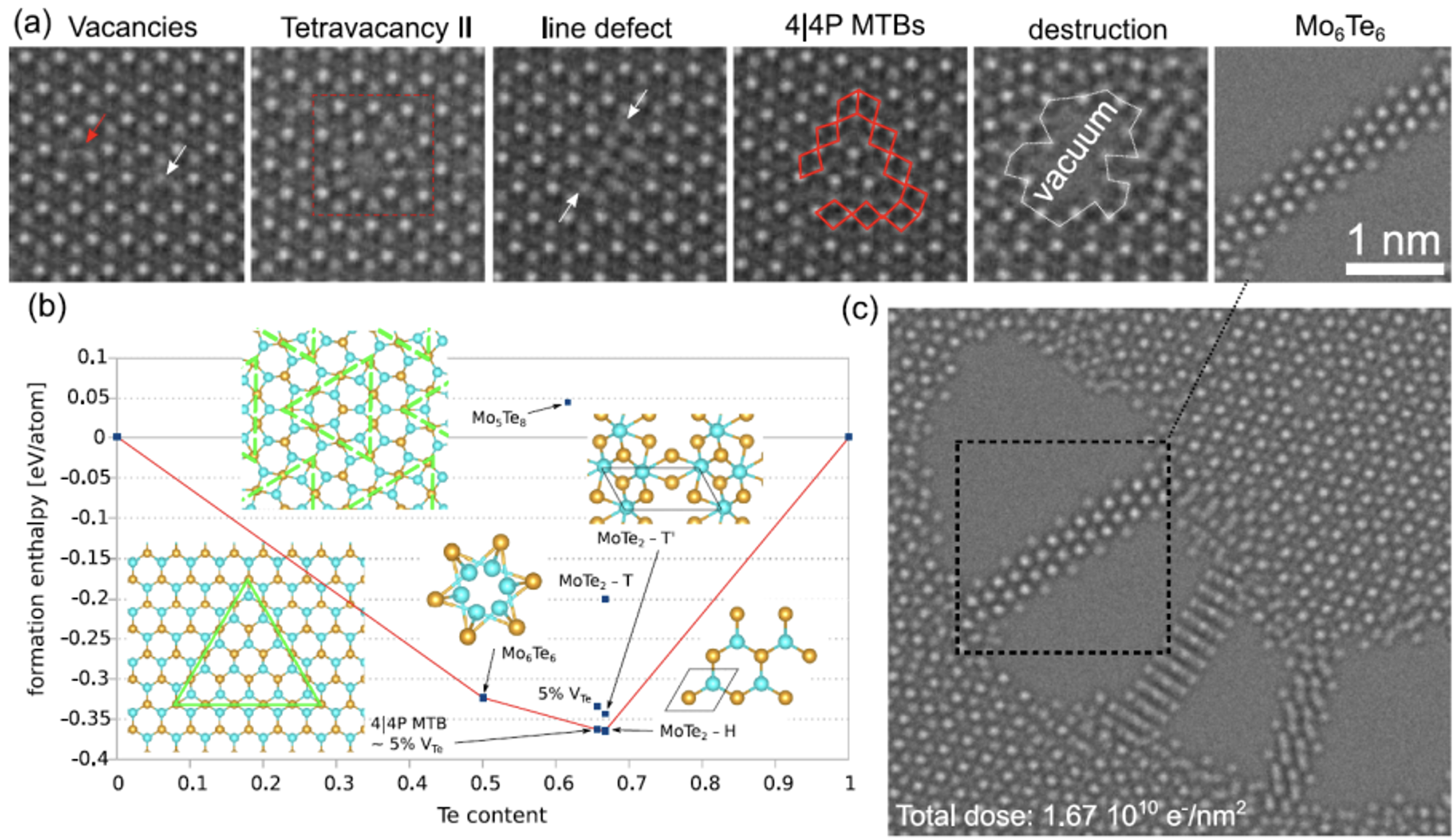
The investigation further examined how accumulated vacancies lead to extended defect structures. High vacancy concentrations can trigger the formation of various extended and linear defects, culminating in 4|4P mirror twin boundaries depending on the specific TMD material. Figure 3(a) illustrates this defect evolution through a sequence of HRTEM images acquired at 80 kV, arranged from left to right with increasing total electron dose. These defect structures are representative of those observed at 60 kV and have been previously documented at 40 kV.[17] The findings indicate that defect evolution follows a similar pathway across the 40–80 kV range, progressing from single defects to extended defects and ultimately to nanowire formation. Notably, the analysis revealed that H-MoTe2 bilayers can withstand several times the total electron dose compared to single layers.
To assess the thermodynamic stability of the experimentally observed structures, the team performed first-principles calculations. The analysis computed enthalpies of formation, with structures having the lowest enthalpy for a given composition considered thermodynamically stable when connected by a convex curve—the well-established convex hull construction.[26] Structures with negative formation enthalpies that lie above the convex hull are thermally unstable or metastable and tend to decompose into stable phases.
The convex hull analysis for various Mo–Te compounds (Figure 3(b)) predicts that both Mo6Te6 nanowires and the H-MoTe2 phase are thermodynamically stable. The energy required to form 4|4P-MTBs in MoTe2 is remarkably low, consistent with earlier calculations.[27] These mirror twin boundaries are energetically more favorable than isolated Te vacancies: for the triangular 4|4P-MTB structure, the formation energy difference ΔE = E(VTe) − E(4|4P-MTB) equals 0.8 eV per vacancy. This energy landscape drives vacancies to aggregate into MTBs. Following defect agglomeration in the hexagonal MoTe2 lattice, crystalline Mo6Te6 nanowires can form (see Figure 3(c)).
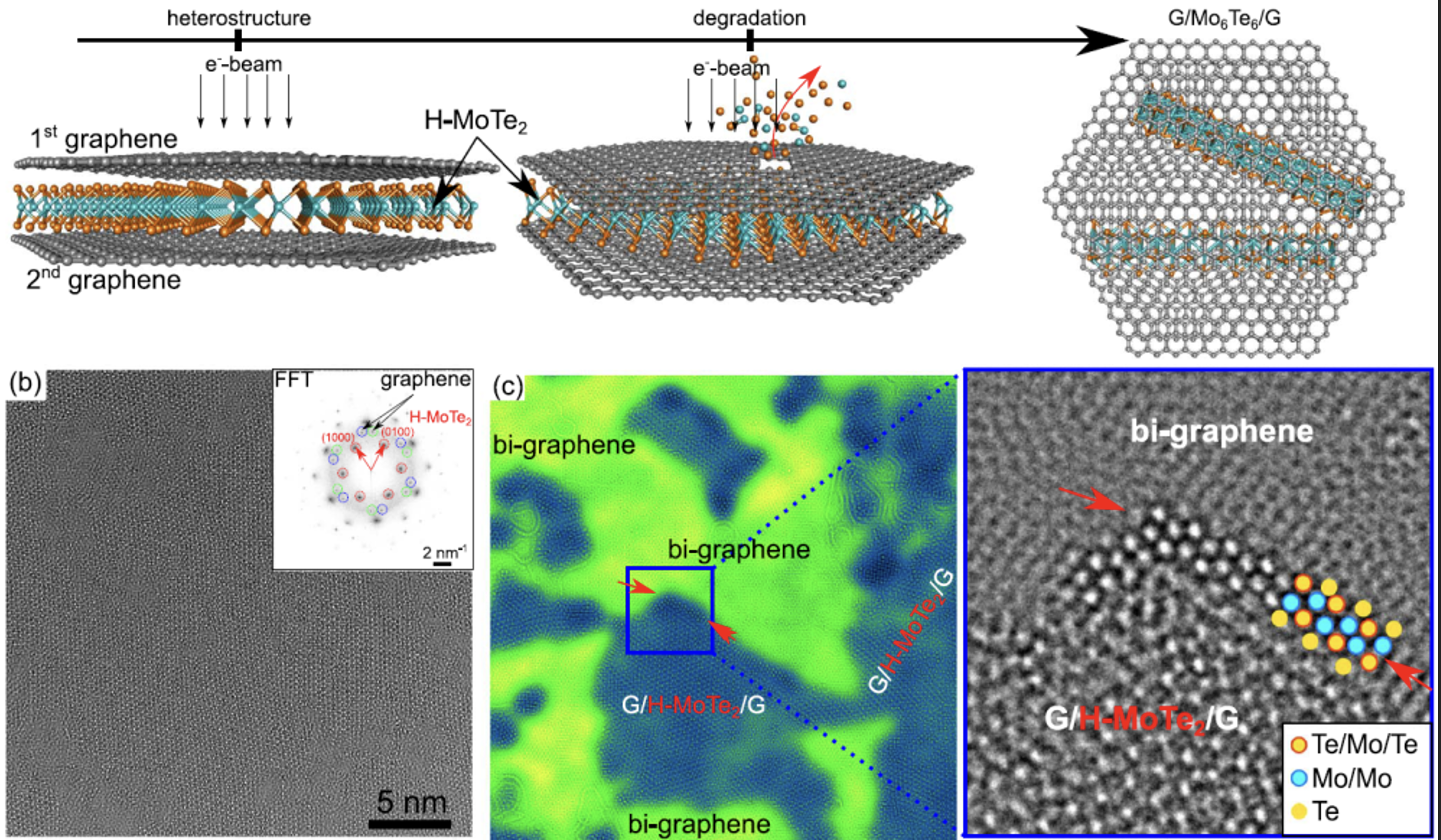
While controlled defect generation offers a proven method for tailoring layer properties, the researchers also demonstrated an approach to prevent radiation damage in H-MoTe2, enabling precise structural analysis even under high electron doses. Figure 4(a) presents a structural model of a vertical G/MoTe2/G heterostructure, where a single MoTe2 layer is sandwiched between two graphene (G) layers. The team fabricated these samples by successively transferring mechanically exfoliated layers onto a Quantifoil grid (see Fig. 4(b)). Experiments with these G/MoTe2/G structures revealed remarkable radiation resistance: this shielding configuration renders MoTe2 virtually indestructible for analysis at 40–80 kV. Unlike freestanding samples, the vacancy concentration in graphene-encapsulated MoTe2 remained unchanged even after electron doses that completely destroyed unprotected targets. The measured damage cross-sections for G/MoTe2/G samples were approximately 0.006 b at 80 kV and approximately 0.005 b at 60 kV.
However, sufficiently high dose rates can induce defects in one or both graphene layers, locally eliminating the protective effect of the graphene sandwich. This allows tellurium and molybdenum atoms to escape from the encapsulation.[28] The released Mo and Te atoms can then form nanowires trapped between (bi)graphene layers (see Figure 4(c)). To verify the protective capability of intact graphene encapsulation, the team annealed graphene-encapsulated single-layer H-MoTe2 in vacuum at 850 °C. In contrast to the significant changes observed in annealing tests on freestanding H-MoTe2 at lower temperatures, the encapsulated samples showed no significant structural modifications.
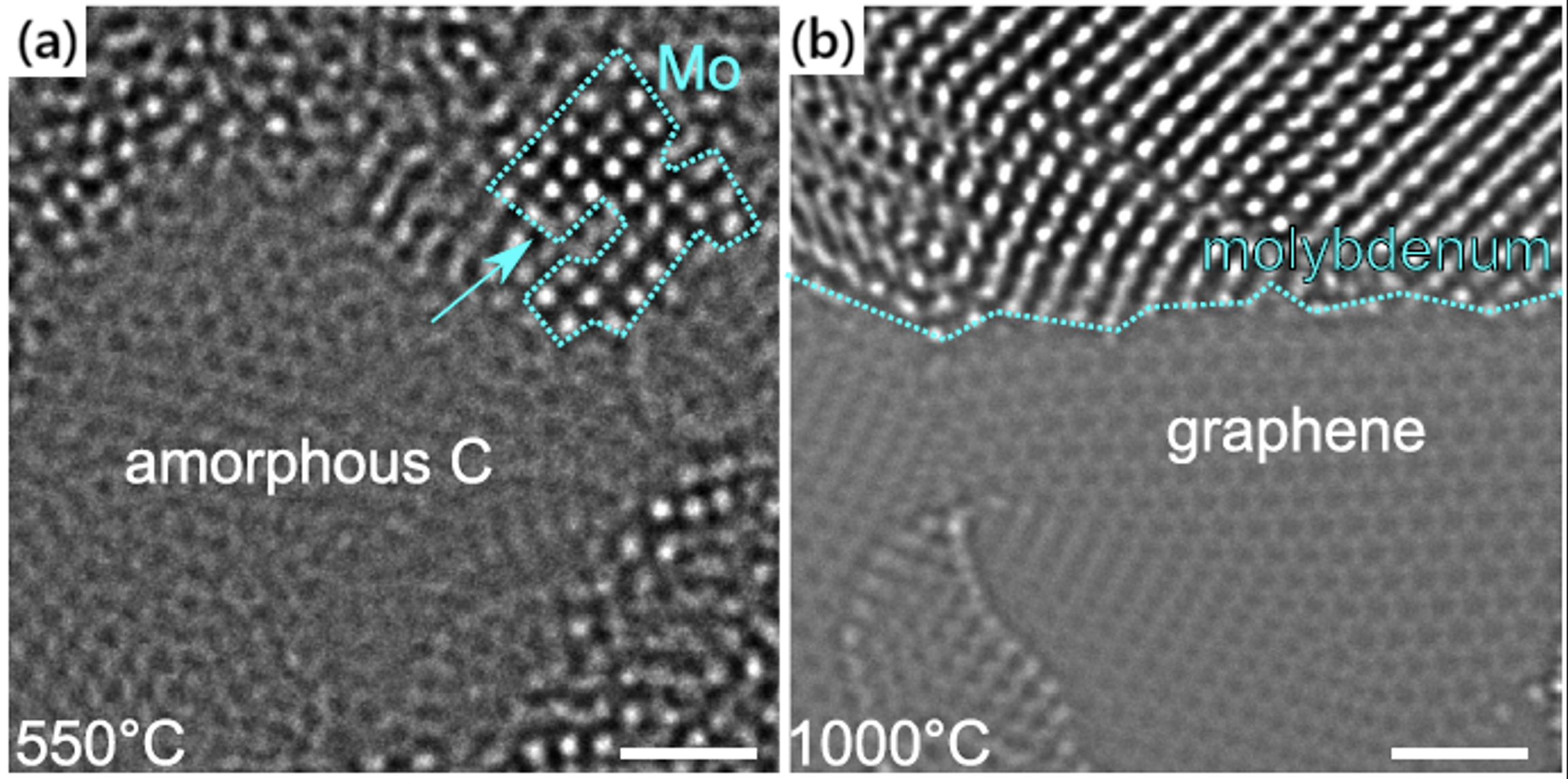
High-temperature annealing experiments on freestanding MoTe2 yielded additional insights into phase transformations. Extended heating led to the formation of pure Mo clusters that no longer contained tellurium residues, as shown in Figure 5(a). EDX analysis of these Mo clusters is provided in the Supporting Information. Furthermore, building on previous annealing experiments with amorphous carbon that demonstrated graphene formation under similar conditions,[29] Figure 5(b) shows that hydrocarbon impurities on the sample surface can form polymorphic carbon films. This graphene formation may have been catalyzed by the metallic Mo crystals.[29]
Resource:
Köster, J., Kretschmer, S., Storm, A., Rasper, F., Kinyanjui, M. K., Krasheninnikov, A. V., Kaiser, U. (2024).
Phase transformations in single-layer MoTe2 stimulated by electron irradiation and annealing.
Nanotechnology 35, 145301.
https://doi.org/10.1088/1361-6528/ad15bb
-
Ruppert, C., Aslan, O. B., and Heinz, T. F. (2014). Optical properties and band gap of single- and few-layer MoTe2 crystals. Nano Lett., 14, 6231–6. https://doi.org/10.1021/nl502557g
-
Lezama, I. G., et al. (2015). Indirect-to-direct band gap crossover in few-layer MoTe2. Nano Lett., 15, 2336–42. https://doi.org/10.1021/nl5045007
-
Cho, S., et al (2015). Phase patterning for ohmic homojunction contact in MoTe2. Science, 349, 625–8. https://doi.org/10.1126/science.aab3175
-
Keum, D. H., et al. (2015). Bandgap opening in few-layered monoclinic MoTe2. Nat. Phys., 11, 482–6. https://doi.org/10.1038/nphys3314
-
Kappera, R., Voiry, D., Yalcin, S. E., Branch, B., Gupta, G., Mohite, A. D., and Chhowalla, M. (2014). Phase-engineered low-resistance contacts for ultrathin MoS2 transistors. Nat. Mater., 13, 1128–34. https://doi.org/10.1038/nmat4080
-
Manzeli, S., Allain, A., Ghadimi, A., and Kis, A. (2015). Piezoresistivity and strain-induced band gap tuning in atomically thin MoS2. Nano Lett., 15, 5330–5. https://doi.org/10.1021/acs.nanolett.5b01689
-
Kretschmer, S., Komsa, H. P., Bøggild, P., and Krasheninnikov, A. V. (2017). Structural transformations in two-dimensional transition-metal dichalcogenide MoS2 under an electron beam: insights from first-principles calculations. J. Phys. Chem. Lett., 8, 3061–7. https://doi.org/10.1021/acs.jpclett.7b01177
-
Shimizu, H., et al. (2022). Formation of a two-dimensional electronic system in laterally assembled wte nanowires. ACS Appl. Nano Mater., 5, 6277–84. https://doi.org/10.1021/acsanm.2c00377
-
Lehtinen, O., et al. (2015). Atomic scale microstructure and properties of se-deficient two-dimensional MoSe2. ACS Nano, 9, 3274–83. https://doi.org/10.1021/acsnano.5b00410
-
Pawar, S. A., et al. (2019). Efficient supercapacitor based on polymorphic structure of 1T'-Mo6Te6 nanoplates and few-atomic-layered 2H-MoTe2: a layer by layer study on nickel foam. Chem. Eng. J., 371, 182–92. https://doi.org/10.1016/j.cej.2019.04.021
-
Le, D., et al. (2013). Growth of aligned Mo6S6 nanowires on Cu(111). Surf. Sci., 611, 1–4. https://doi.org/10.1016/j.susc.2012.12.016
-
Kim, H., Johns, J. E., and Yoo, Y. (2020). Mixed-dimensional in-plane heterostructures from 1D Mo6Te6 and 2D MoTe2 synthesized by Te-flux-controlled chemical vapor deposition. Small, 16, 2002849. https://doi.org/10.1002/smll.202002849
-
Tarascon, J. M. (1985). Mo6Se6: a new solid-state electrode for secondary lithium batteries. J. Electrochem. Soc., 132, 2089–93. https://doi.org/10.1149/1.2114297
-
Tarascon, J. M. (1986). Topotactic redox reactions of one-dimensional ternary molybdenum chalcogenides Mo6X6 (X = Se, Te). Solid State Ionics, 18–19, 802–6.
-
Schleberger, M., and Kotakoski, J. (2018). 2D material science: defect engineering by particle irradiation. Materials, 11, 1885. https://doi.org/10.3390/ma11101885
-
Kretschmer, S., Lehnert, T., Kaiser, U., and Krasheninnikov, A. V. (2020). Formation of defects in two-dimensional MoS2 in the transmission electron microscope at electron energies below the knock-on threshold: the role of electronic excitations. Nano Lett., 20, 2865–70. https://doi.org/10.1021/acs.nanolett.0c00670
-
Lehnert, T., Ghorbani-Asl, M., Köster, J., Lee, Z., Krasheninnikov, A. V., and Kaiser, U. (2019). Electron-beam-driven structure evolution of single-layer MoTe2 for quantum devices. ACS Appl. Nano Mater., 2, 3262–70. https://doi.org/10.1021/acsanm.9b00616
-
Köster, J., Ghorbani-Asl, M., Komsa, H. P., Lehnert, T., Kretschmer, S., Krasheninnikov, A. V., and Kaiser, U. (2021). Defect Agglomeration and electron-beam-induced local-phase transformations in single-layer MoTe2. J. Phys. Chem. C, 125, 13601–9. https://doi.org/10.1021/acs.jpcc.1c02202
-
Batzill, M. (2018). Mirror twin grain boundaries in molybdenum dichalcogenides. J. Phys. Condens. Matter, 30, 493001. https://doi.org/10.1088/1361-648X/aae9cf
-
Liu, X., et al. (2013). Top-down fabrication of sub-nanometre semiconducting nanoribbons derived from molybdenum disulfide sheets. Nat. Commun., 4, 1776. https://doi.org/10.1038/ncomms2803
-
Lehnert, T., Lehtinen, O., Algara-Siller, G., and Kaiser, U. (2017). Electron radiation damage mechanisms in 2D MoSe2. Appl. Phys. Lett., 110, 033106. https://doi.org/10.1063/1.4973809
-
Algara-Siller, G., Kurasch, S., Sedighi, M., Lehtinen, O., and Kaiser, U. (2013). The pristine atomic structure of MoS2 monolayer protected from electron radiation damage by graphene. Appl. Phys. Lett., 103, 203107. https://doi.org/10.1063/1.4830036
-
Linck, M., et al. (2016). Chromatic aberration correction for atomic resolution TEM imaging from 20 to 80 kV. Phys. Rev. Lett., 117, 076101. https://doi.org/10.1103/PhysRevLett.117.076101
-
Speckmann, C., et al. (2023). Combined electronic excitation and knock-on damage in monolayer MoS2. Phys. Rev. B, 107, 094112. https://doi.org/10.1103/PhysRevB.107.094112
-
Komsa, H. P., Kotakoski, J., Kurasch, S., Lehtinen, O., Kaiser, U., and Krasheninnikov, A. V. (2012). Two-dimensional transition metal dichalcogenides under electron irradiation: defect production and doping. Phys. Rev. Lett., 109, 035503. https://doi.org/10.1103/PhysRevLett.109.035503
-
Bartel, C. J. (2022). Review of computational approaches to predict the thermodynamic stability of inorganic solids. J. Mater. Sci., 57, 10475–98. https://doi.org/10.1007/s10853-022-06915-4
-
Komsa, H. P., and Krasheninnikov, A. V. (2017). Engineering the electronic properties of two-dimensional transition metal dichalcogenides by introducing mirror twin boundaries. Adv. Electron. Mater., 3, 1600468. https://doi.org/10.1002/aelm.201600468
-
Lehnert, T., Kretschmer, S., Bräuer, F., Krasheninnikov, A. V., and Kaiser, U. (2021). Quasi-two-dimensional NaCl crystals encapsulated between graphene sheets and their decomposition under an electron beam. Nanoscale, 13, 19626–33. https://doi.org/10.1039/d1nr04792b
-
Orofeo, C. M., Ago, H., Hu, B., and Tsuji, M. (2011). Synthesis of large area, homogeneous, single layer graphene films by annealing amorphous carbon on Co and Ni. Nano Res., 4, 531–40. https://doi.org/10.1007/s12274-011-0109-x